Brooks School Spotlight: Meet Adam Howell, Outreach Director for NY FarmNet
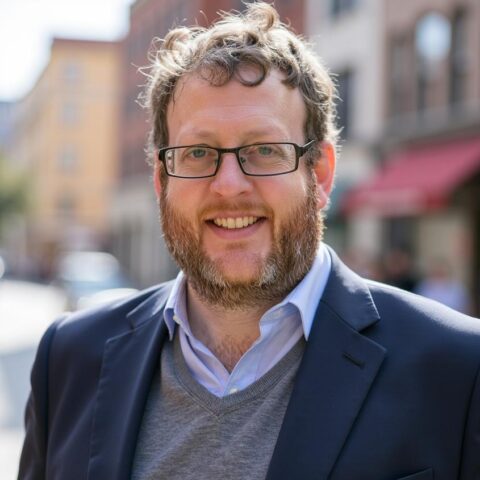 Adam Howell is Outreach Director for NY FarmNet, a Cornell program that provides free, confidential financial and family consultation to farmers and farm families across New York State.
He leads the program’s marketing, communications, and outreach, helping share the stories of New York farmers and the work of NY FarmNet’s consultants. Howell is also an employee degree student in the Brooks School’s Executive Master of Public Administration (EMPA) program.
Q: Can you tell us a little about your background and what ultimately brought you to Cornell and NY FarmNet?
My background is in public policy. My wife and I both worked in the Illinois governor’s office for almost a decade. We actually met in the governor’s office and worked many years in politics.
After a while, we decided it would be fun to make a change, and she got an opportunity in New York, so we moved out here. It’s beautiful. We love nature, the hills and streams and lakes, and all the beauty of upstate New York.
I was lucky enough to start at Cornell in 2017, working in communications with the Local Roads Program. It was a nice transition because they work with local highway agencies, local government, and rural communities, which is my area. I had done similar work in Illinois.
I spent about five years there, left briefly to work remotely for a national nonprofit in Washington, D.C., and then came back to Cornell to work for NY FarmNet. It’s a very rural-focused, community-based approach to marketing and communications. It’s a lot of storytelling, which I love.
A few years ago, through the employee benefit Cornell provides, I took Professor O’Toole’s public administration class. I did well enough to be invited to apply for the EMPA program, and that’s how I ended up here. It’s been wonderful.
Q: For someone unfamiliar with NY FarmNet, what does the program do, and what does your role as outreach director look like?
NY FarmNet is an interdepartmental program under both the College of Agriculture and Life Sciences and the SC Johnson College of Business. The program is funded mostly by the New York State Department of Agriculture and Markets, with support from the Office of Mental Health, agricultural banks, and Cornell.
NY FarmNet provides free, confidential consultation to any farmer of any size, of any commodity type, anywhere in New York State. It’s 100% free and 100% confidential.
We send out two types of consultants. One helps farmers deal with financial or business-related problems, including taxes, succession planning, understanding profit and loss sheets, and business management. On the other hand, we deploy specialized social workers with unique experience in rural agricultural settings. They work with farm families on mental health, family communication, anxiety, stress, and conflict.
When the program started in 1986, we found that farming is an interconnected discipline and vocation in which the business is closely tied to the personal, cultural, and family aspects of farmers’ lives. Farming operations are usually family operations, and farmers are often working at or near their homes. You have to combine a holistic support approach that intermingles financial well-being with mental health and personal well-being.
As outreach director, I’m the lucky person who gets to go out there and evangelize the program. I get to tell the story of NY FarmNet. I’m responsible for marketing, communications, digital outreach, and press relations, and I run all of our digital properties. My job is to get people to consider using our program, explain what we do, and engage policymakers and decision-makers about the great work our consultants do. It’s really a dream job.
Q: NY FarmNet takes a holistic approach to supporting farmers and farm families. Why is it important to look at financial, family, and mental health challenges together?
When our program first began, we only provided financial consultation. It was during a very deep financial crisis in the agricultural sector in the 1980s—the farm crisis of the 1980s.
We provided financial consultation and support, but we heard from farm financial experts that the underlying problems were far beyond their expertise. They had to do with things like substance abuse, deep family conflict, and marital issues that were affecting the business but that a financial consultation approach couldn’t solve alone.
No matter how good your balance sheet is, if the mental health of you, your employees, or your family is not there, then that financial element is going to drop off. The farm is the family and the identity of the individual just as much as it is a business.
Farmers do not get to take time off. They don’t get the kind of separation that many of us do at the end of the day. They oftentimes don’t get vacations. They’re also at the mercy of a lot of variables they can’t control: prices, weather, illness of animals or herds, trade, and labor.
If you don’t address the mental health side, you’ll never get the business in shape, and vice versa. If the business is in decline, the mental health of the farmer is going to be impacted.
We also don’t just help people during times of crisis. We help people who are doing well. Succession planning or business expansion can cause stress and conflict, even if the business is doing well. So we’re preventative as much as we’re reactive.
Q: What are some of the unique challenges farmers and rural communities face when it comes to mental health and asking for support?
Isolation and a lack of convenient support. One thing people don’t realize is that farmers live in rural areas, and most rural counties throughout New York State are designated mental health shortage areas. There are not enough clinicians or supportive services to meet the need.
You tack on the fact that farmers and people in agriculture work in a very unique cultural setting. They are less likely to actually go into town to seek services because they don’t want to be seen in a small community as seeking services. They know that other people know their truck and know who they are.
To this day, there’s still an enormous amount of stigma in rural areas around judging people who seek help, or even understanding what help is. We call that mental health literacy.
There are socioeconomic and other social determinants of mental health that make these populations higher risk. The work is more dangerous, and injury or illness can impact someone’s mental health.
You have a lot of things that make the problem more prevalent, but the ability to find support—or even the desire to seek support—is less accessible.
Q: What is most meaningful to you about working with New York’s farmers and farm families?
I get to work with some amazing people—our consultants. This is a part-time job for the vast majority of our consultants. Many of them have spent years, if not generations within their families, working in and around agriculture. It’s a passion for them. It’s a labor of love.
When we can help and see our clients flourish, it’s gratifying for me, and it’s wonderful to see the pride our consultants take in their success.
I’m uniquely privileged because I get to tell all these positive stories. I get to do photo shoots and interviews with farmers who have been our clients and had good experiences. Many are farmers who have expanded and grown or successfully transitioned into retirement, and then they see their kids and grandkids taking on the farm.
The culture of agriculture is really heartwarming and really unique in New York. New York has a huge amount of diversity. You’ve got maple producers, fruit growers, and dairy. To see what people are doing to bring agriculture back to a community level and understand that it’s part of our culture is exciting, and we’re a part of that.
If NY FarmNet worked itself out of a job to the point where nobody needed help anymore, I would be totally okay with that. I think everybody else would, too. But until then, we get to be a part of that story.
Q: You’re also currently a student in the Executive Master of Public Administration program. What made you decide to pursue an EMPA at this point in your career?
First, working at Cornell is really inspiring. I’m in my early 40s, and for many years it wasn’t even on my radar to want to go back and enhance my education. But being here with people like Tom O’Toole and the many great friends who are professors and work on the academic side of things has inspired me to further my education.
I come from a background in government and public administration. I want mental health to be more of a topic of conversation in that field. The Brooks School and the EMPA program give me the opportunity to do that work and have taught me how to investigate those issues through research, surveys, and interviews.
I honestly think Cornell inspires people to want to grow in terms of knowledge and education. It’s just a natural part of the environment here. It’s been wonderful and very supportive.
Q: How does what you’re learning in the EMPA connect with your work at NY FarmNet?
The ability to strategically analyze a program, better define performance metrics for success, and define your goals better has been really valuable. There’s been a lot of good instruction on how to professionally understand how to make a program work better or how to make a support model work better.
It’s also creatively inspiring because what I want to do is take that NY FarmNet model and make a unique twist on it to make it work for local governments. It’s given me the tools to creatively develop a new model of support—not just improve what’s there, but create something new that can maybe bring that help to people working in local government or public service throughout New York State and beyond.
It’s given me a lot of tools: financial analysis, human resources, communications, research, and applying that research to an operational program.
Q: What has your experience in the EMPA program been like so far, particularly learning alongside other working professionals?
I think I’m lucky because it feels like we have a uniquely close cohort. We’ve settled into a friendship where we’re all interested in talking about what we do professionally and learning about each other’s roles.
We have a lot of military members in our cohort, and that diversity of perspective has really shaped my work through the great feedback I’ve gotten, the encouragement we provide each other, and using each other as resources.
There are people in the mental health space, or at least the substance use disorder space, who are similar. Others are developing unique support models for veterans or people working in the federal government.
I think that’s probably one of the more beneficial things: you arrive as a cohort, you get to know each other, and then you build on each other as a resource just as much as the material or the professors.
Q: Looking ahead, how do you hope to use your EMPA to build on your work at NY FarmNet?
I want to get the word out about mental health and local public service. The idea is that I’m going to keep continuing the research as long as I can, even beyond the MPA program, with the goal of creating a model—an actual way to apply it that organizations can afford, adapt, and use to improve the situation for their employees.
We’re finding that stress and burnout are so high that my fear is, especially in small towns and vulnerable communities, we’re going to see a collapse of that critical human infrastructure. I want to help shore that up.
Mental health training, education, building systems, improving the communications local governments have, and improving relationships with their communities—if we can turn all that into a support model we can apply and then refine, that’s what I want to do.
This interview has been edited for length and clarity.

Differentiate yourself as an executive across the public, private, and nonprofit sectors
The Executive Master of Public Administration (EMPA) program at the Cornell Brooks School is an interdisciplinary degree designed for working professionals who want to develop new skills and networks, and take their careers in public affairs in new directions.