
Two students walking on a sidewalk in Washington DCIn Summer 2027, students can choose from four two-week courses offered across two sessions. Each course offers 2 college credit hours and combines seminar-style coursework with immersive experiential learning in the nation’s capital.

Students may participate in one two-week session taking one course and earning 2 college credit hours; or attend both sessions, taking one course during each session and earning a total of 4 college credit hours.

This non-residential program is housed at the Cornell Brooks School’s centrally located Cornell in Washington campus in Dupont Circle.

Application Open Date: November 1, 2026
Priority Application Deadline: February 1, 2027
Application Deadline: April 1, 2027

Thanks to generous support, we can offer scholarships to student applicants!

Apply Here      FAQs     Request More Info

Being able to gain Cornell credit while interacting hands-on with real changemakers has definitely been one of the highlights of my summer.

– Nawid S., DC Summer Policy Institute student

DC Summer Policy Institute Quick Facts

Red calendar icon

Two 2-week Sessions

Session 1: July 6–16, 9:00am–4:00pm
Session 2: July 19–30, 9:00am–4:00pm

red graduation cap icon

2 college credit hours per course

Choose between four courses for college credit.
See course options below

red location icon

Cornell in Washington’s Wolpe HALL 

22nd and O St. in Washington D.C.
Above all, the unique field trips, guest lectures, and connections I built with peers from diverse regions broadened my horizons and made for a truly remarkable period of personal growth.

– Nathen P., DC Summer Policy Institute student

Program Details

Eligibility

Applicants must:

  • Be 15–19 years old and have completed their sophomore year of high school by the program start date (July 6, 2027).
  • Reside in the Washington, DC Metropolitan area for commuting.
    • If a student lives outside of the DC Metropolitan Area and is interested in participating in the program, the following requirements must be met:
      • For students under 18 years old:
        Students may attend if their parent(s)/guardian(s) attest that temporary housing and a supervising adult will be arranged for all times the student is not on campus.
      • For students 18 or 19 years old:
        Students may attend and are responsible for managing their own housing arrangements.
  • Be a U.S. citizen or permanent resident. The Brooks School DC Summer Policy Institute does not offer F-1 or J-1 sponsorship, and international student applicants are responsible for checking with a qualified immigration attorney or their Designated School Official (DSO) at their home institution regarding their eligibility for the program.
  • Demonstrate academic readiness and personal maturity.

How to Apply

Application Open Date: November 1, 2026
Priority Application Deadline: February 1, 2027
Application Deadline: April 1, 2027

For students interested in applying for the Summer 2027 program, the following materials are required:

  • Application form
  • Resume (including achievements, extracurriculars, or prior pre-college coursework)
  • School transcript(s)
  • One letter of recommendation (principal, counselor, advisor, mentor, or teacher)
  • A 500-word essay answering the writing prompt: Tell us about your background, interests, and how participating in the Cornell Summer Policy Institute would advance your goals. 


For questions or additional information, please email us at brookssummer@cornell.edu.

Program Cost

Thanks to generous support, we can offer scholarships to student applicants!

  • Participants who apply by February 1, 2027, will benefit from a discounted program tuition and fees of $5,300 for one session.
  • Starting February 2, 2027, program tuition and fees will total $5,800 for one session.
  • A non-refundable $500 deposit is due to secure a spot.

“Amy truly enjoyed the experience, especially learning about healthcare policy and the academic environment at Cornell. The program strengthened her interest in public policy and made Cornell one of the universities she hopes to apply to for college.” — Parent of a DC Summer Policy Institute student

Course Options

Students can choose from four courses offered across two summer sessions. Students may enroll in one course per session and can attend one or both sessions.

Session 1: Promoting Youth Well-Being in the Age of Social Media: Practical and Policy Solutions

Instructor: Dana Weiner

Dates: July 6–16, 2027
Session 1: Tuesday–Saturday, July 6-10; Monday–Friday, July 12-16

  • One Saturday session is included (July 10) to accommodate the Fourth of July holiday.

Credits: Two college credit hours

Promoting Youth Well-Being in the Age of Social Media: Practical and Policy Solutions is a two-week intensive Cornell Brooks D.C. Summer Policy Institute course designed for rising high school juniors and seniors interested in understanding how social media affects young people’s lives and exploring practical and policy solutions to promote youth well-being.

How does social media influence adolescent brain development, sleep, self-image, mental health, and relationships? What can young people, families, schools, and communities do to reduce potential harms? And what role should government play in protecting young people online? In this course, students examine the research on social media’s impacts while exploring strategies to promote healthier digital experiences, including public awareness campaigns, digital literacy initiatives, and approaches to reducing harmful social media use.

Students also explore how public policy shapes both the digital environment and the systems that support young people with a specific focus on recent legal decisions that have the potential to reshape the way young people relate to and within social media platforms. The course also introduces students to the landscape of youth mental health services, including school-based supports, community mental health programs, healthcare providers, and public systems that finance and coordinate services. Students consider how these systems work together, where gaps in access and services exist, and how policy can improve support for young people and families.

Through real-world case studies, policy debates, and hands-on activities, students develop foundational skills in evaluating research evidence, understanding adolescent development, analyzing public policy, assessing the effectiveness of programs and interventions and identifying levers for change. They explore how policies are developed, implemented, and evaluated, as well as how organizations and service systems can adapt to meet emerging challenges. Ideal for students interested in public policy, psychology, mental health, law, or social change, this course offers an opportunity to develop and evaluate evidence-informed solutions to one of the most pressing challenges facing young people today.


Session 1: Details Coming Soon!

Dates: July 6–16, 2027
Session 1: Tuesday–Saturday, July 6-10; Monday–Friday, July 12-16

  • One Saturday session is included (July 10) to accommodate the Fourth of July holiday.


Session 2: Powering the Future: Energy, Environment, and Public Policy

Instructor: Gavin Mosley

Dates: July 19–30, 2027
Session 2: Monday–Friday, July 19-23; Monday–Friday, July 26-30

Credits: Two college credit hours

Powering the Future: Energy, Environment, and Public Policy is a two-week intensive Cornell Brooks D.C. Summer Policy Institute course designed for rising high school juniors and seniors interested in understanding the environmental and energy challenges facing society and how public policy can address them.

How do governments decide which energy sources to support and how to regulate their environmental impacts? What roles do businesses, communities, and policymakers play in shaping our energy future? How can societies balance economic growth, energy needs, environmental protection, and the interests of different communities? In this course, students explore the historical forces, economic considerations, and political decisions that shape energy and environmental policy in the United States and around the world.

Students begin by examining the origins of the modern environmental movement and how major historical developments, from industrialization and suburban growth to advances in technology, have shaped contemporary environmental challenges. They then investigate current policy debates surrounding energy production and consumption, environmental regulation, and emerging demands for resources, including the growing energy needs of data centers and artificial intelligence. Through case studies, students examine landmark environmental legislation, the roles of government at different levels, and how policy decisions affect communities differently, including urban, rural, and historically disadvantaged populations.

Throughout the course, students develop skills in evaluating policy evidence, analyzing competing perspectives, and assessing the economic, environmental, and social tradeoffs of different policy approaches. Through discussions, applied policy exercises, and experiential learning opportunities in Washington, D.C., students gain firsthand insight into how environmental policies are developed, debated, and implemented. Ideal for students interested in public policy, environmental studies, economics, politics, or sustainability, this course provides an interdisciplinary introduction to the decisions that will shape our energy and environmental future.

Session 2: Democracy Policy in the World

Instructor: Thomas E. Garrett 

Dates: July 19–30, 2027
Session 2: Monday–Friday, July 19-23; Monday–Friday, July 26-30

Credits: Two college credit hours

Democracy Policy in the World is a two-week intensive Cornell Brooks D.C. Summer Institute course designed for rising high school juniors and seniors who want to understand how democracy operates on the global stage.

How do democratic systems across different countries work with one another? What happens when democratic principles collide with power politics, global inequality, and political polarization? In this course, students explore the ideas, norms, institutions, and real-world challenges that shape democracy policy in today’s international system.

Students are introduced to foundational theories of democracy and examine how those ideas influence diplomacy and international policymaking. Through case studies and discussion, they analyze a world in transition, where rules-based international cooperation increasingly competes with power-based approaches, and where polarization exists both within countries and across regions.

The course emphasizes active engagement. Students build practical skills for analyzing policy issues, understanding diplomatic processes, and thinking critically about how democratic values can be supported around the world. Designed as a rigorous global citizenship training experience, this course encourages students to see themselves as informed, engaged participants in democratic life and prepares them to continue exploring democracy and international policy in their future studies and careers.

Learn Beyond the Classroom

The DC Summer Policy Institute combines seminar-style coursework with experiential learning throughout Washington, D.C.

During each two-week session, students will participate in approximately three to four experiential learning opportunities that connect what they are studying in the classroom with public policy in action.

These experiences give students the opportunity to learn from policymakers and practitioners, visit organizations working on public policy issues, and explore the institutions and organizations that shape policy in Washington.

Example Past Experiential Learning Opportunities:

  • A guided tour of Children’s National Hospital
  • An inside look at the National Endowment for Democracy
  • Meeting the Secretary General of the Organization of American States
  • Visits to the Embassies of Estonia and Antigua and Barbuda, including a meeting with an Ambassador
  • A health policy visit to Capitol Hill, where students met with a U.S. Senator
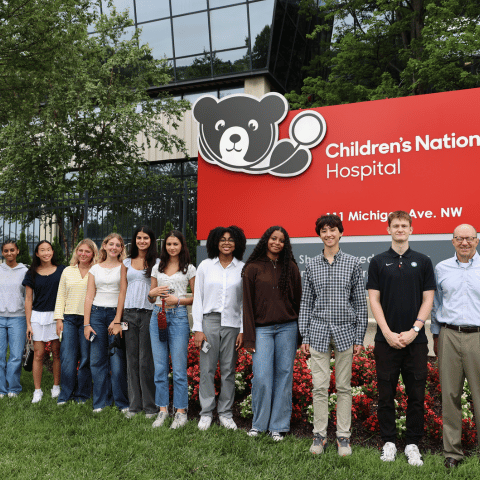
Group of students standing in front of red Children's National Hospital sign

My favorite part was our trip to the children’s hospital. We got a tour of the hospital and got to experience firsthand how the concepts that we were learning in class can be applied to real-world scenarios.

– DC Summer Policy Institute student

Have Questions?
Capitol Building with red overlays

Cornell Brooks School

Cornell in Washington
DC Summer Policy Institute