News
Fiscal Effects of a De Minimis Exclusion for Personal Digital-Asset Payments
 A new report from Cornell’s Tech Policy Institute examines the federal revenue implications of the proposed de minimis exclusion for small personal digital-asset transactions in Section 2 of S. 2207. The analysis considers both the revenue currently collected from taxable digital-asset payments and how consumers may respond if transaction-level tax and reporting burdens are reduced. It finds that, under the report’s central assumptions, the exemption could increase rather than reduce federal revenue. If qualifying digital-asset payment volume doubles, the provision reaches fiscal break-even when roughly 10% of the additional payment volume represents purchases that would not otherwise have occurred. Under the report’s illustrative central scenario, the estimated net effect is approximately $859 million in additional federal revenue over ten years. The report highlights a broader consideration for tax policy: fiscal effects depend not only on statutory tax rates, but also on actual compliance, collections, and behavioral responses.
Link to Fiscal Effects of a De Minimis Exclusion for Personal Digital-Asset Payments
Tech Policy Institute Collaborates with Bitcoin Policy Institute and Fedi To Launch New 2-Year Study
Drone Vulnerabilities and the Threat of Directed Energy Weapons to Drone Survival
 On Friday, January 23rd, Cornell Brooks Tech Policy Institute Director’s Fellow John Miller gave a seminar on how drone warfare has evolved over the past decade and what it means for future conflict. He traced the shift from expensive, high‑end systems like the Predator and Reaper to cheap, mass‑produced DJI‑scale platforms now central to the war in Ukraine, where entire units are dedicated to drone production, modification, and employment. John highlighted how existing taxonomies of drones fail to capture operational realities and explained his current research on drone fault hierarchies and vulnerabilities, including GPS spoofing, communications jamming, and emerging directed‑energy threats. He noted that while many electronic warfare risks can be mitigated through advanced signal processing and software, high‑energy lasers pose a growing challenge as more states develop scalable directed‑energy systems. His ongoing work explores low‑cost sensing solutions that could help drones detect laser targeting in milliseconds and enable swarm‑level evasive behaviors, with implications for both U.S. doctrine and adversary counter‑drone strategies.
Cornell Tech Policy Institute Hosts Senior Director at Cisco
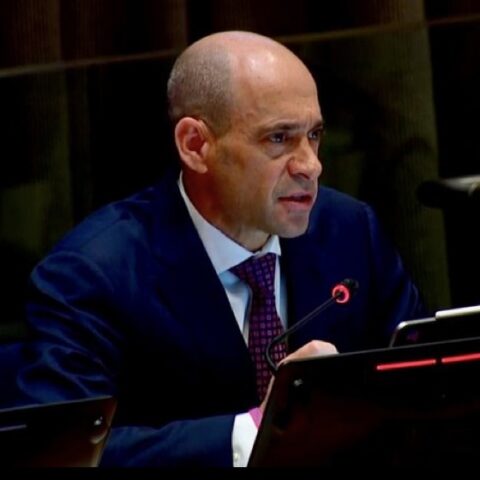 Eric Wenger (‘90) – Senior Director for Cyber and Emerging Tech Policy at Cisco, addressed more than 250 students.

The Challenges of Responsible AI: When Trust Becomes Scarce Fiona Neibart For much of the past year, the debate over AI has been framed as a contest between regulation and innovation, as if the two pull in opposite directions. However,...
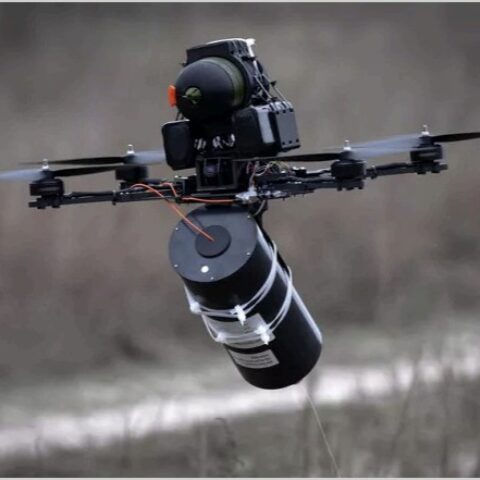
Who Draws the Line on Dual-Use Defense Technology? Sumajja Denysiuk There is a line somewhere between a commercial drone and an Unmanned Combat Aerial Vehicle (UCAV), between a data analytics platform and a targeting system, between...

TPI Helps to Secure NATO Allies from the Threat of Drones Today the Tech Policy Institute and the Icelandic think tank Varða are publishing Detect and Deter: Drone Threats, Governance Gaps, and the Future of Icelandic Defence, the...

Guðni Thorlacius Jóhannesson, former President of Iceland (2016–2024) and current Professor of History at the University of Iceland, visited Cornell University last week to deliver three Messenger Lectures, reflecting on his...

The 2025 U.S. National Security Strategy and Great Power Competition By Fiona Neibart The Trump administration’s November 2025 National Security Strategy (NSS) reframes technological innovation as leverage rather than a shared asset...

2000 METERS TO ANDRIIVKA- A film by Mstyslav Chernov Follows Ukrainian soldiers fighting for every meter of land during the war sparked by Russia’s Full-Scale Invasion of Ukraine. Shot on the front lines, it captures the brutal...
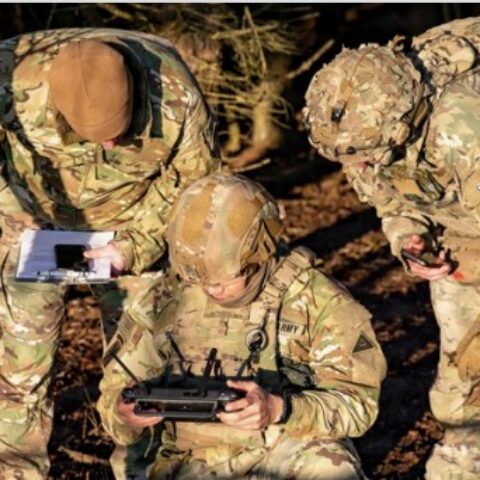
Defending America Against Drones; A Whole-of-Government Approach Paul Lushenko and Joseph Amoroso On October 7, 2023, Hamas used drones to initiate its attack on Israel. On June 1, 2025, Ukraine conducted Operation Spider Web, using over...

Earlier this semester, Tech Policy Institute Senior Fellows Paul Lushenko and Keith Carter guided a bipartisan national security threat simulation hosted by the Brooks School’s Institute of Politics and Global Affairs (IOPGA) at the U.S....
The Cornell Tech Policy Institute (TPI) has published its 2024–25 Annual Report, reflecting a year of growth as technology and security questions moved to the center of public policy. The report outlines TPI’s continued work across...